










The CiviClick Playbook, 24 Principles That Power Modern Advocacy

Advocacy doesn’t succeed by accident. It wins through focus, discipline, systems, and people who are empowered to take action.
Over the past month, we shared 24 ideas that shape how we think about advocacy at CiviClick. Each one was inspired by a leadership, product, or strategy framework that has shaped high-performing organizations across industries.
Together, they form a clear philosophy, one that defines how modern advocacy teams should operate in 2026 and beyond.
Below is the complete CiviClick playbook.
1. Focus on the ONE Thing That Actually Moves Policy
The single most important metric in advocacy is engagement.
Not list size. Not impressions. Action.
CiviClick is built to turn passive supporters into active advocates, predictably and at scale.
2. Ownership Wins Campaigns
Teams perform better when they feel ownership of the mission.
The same is true for supporters.
Clear calls-to-action, intuitive workflows, and seamless UX create advocates who feel responsible for outcomes, not just observers of them.
3. Scaling Advocacy Is a System, Not Luck
Successful advocacy scales the same way modern SaaS companies do:
- Short feedback loops
- Rapid testing
- User-centric design
CiviClick applies these principles to public policy engagement.
4. The Right People Need the Right Tools
Great organizations don’t just get the right people on the bus, they give them tools that amplify their impact.
Data, personalization, and multichannel outreach are no longer optional for advocacy teams that want to move from good to great.
5. Advocacy Is Negotiation at Scale
Every campaign is a negotiation between values, timing, and influence.
Effective advocacy uses tactical empathy, messages that land, moments that matter, and relationships built on relevance rather than noise.
6. Great Leaders Multiply Their Supporters
The strongest advocacy organizations don’t do the work themselves, they empower thousands of supporters to act.
CiviClick functions as a force multiplier, making participation simple, fast, and intuitive for everyone involved.
7. Data Wins Policy Battles
Modern advocacy borrows from modern campaigns.
Segmentation, testing, and behavioral insight turn raw enthusiasm into measurable outcomes and sustained pressure.
8. Close the Gap Between Now and the Outcome You Need
Advocacy exists to close a gap:
- Between the current reality
- And the policy outcome that matters
Clear stakes and problem-centric messaging are what activate people to move.
9. Complexity Is the Enemy of Execution
Public policy is messy. Advocacy doesn’t need to be.
Target the right lawmakers. Activate the right advocates. Measure what matters. Then repeat.
10. Visibility Creates Repeatable Success
What gets tracked gets improved.
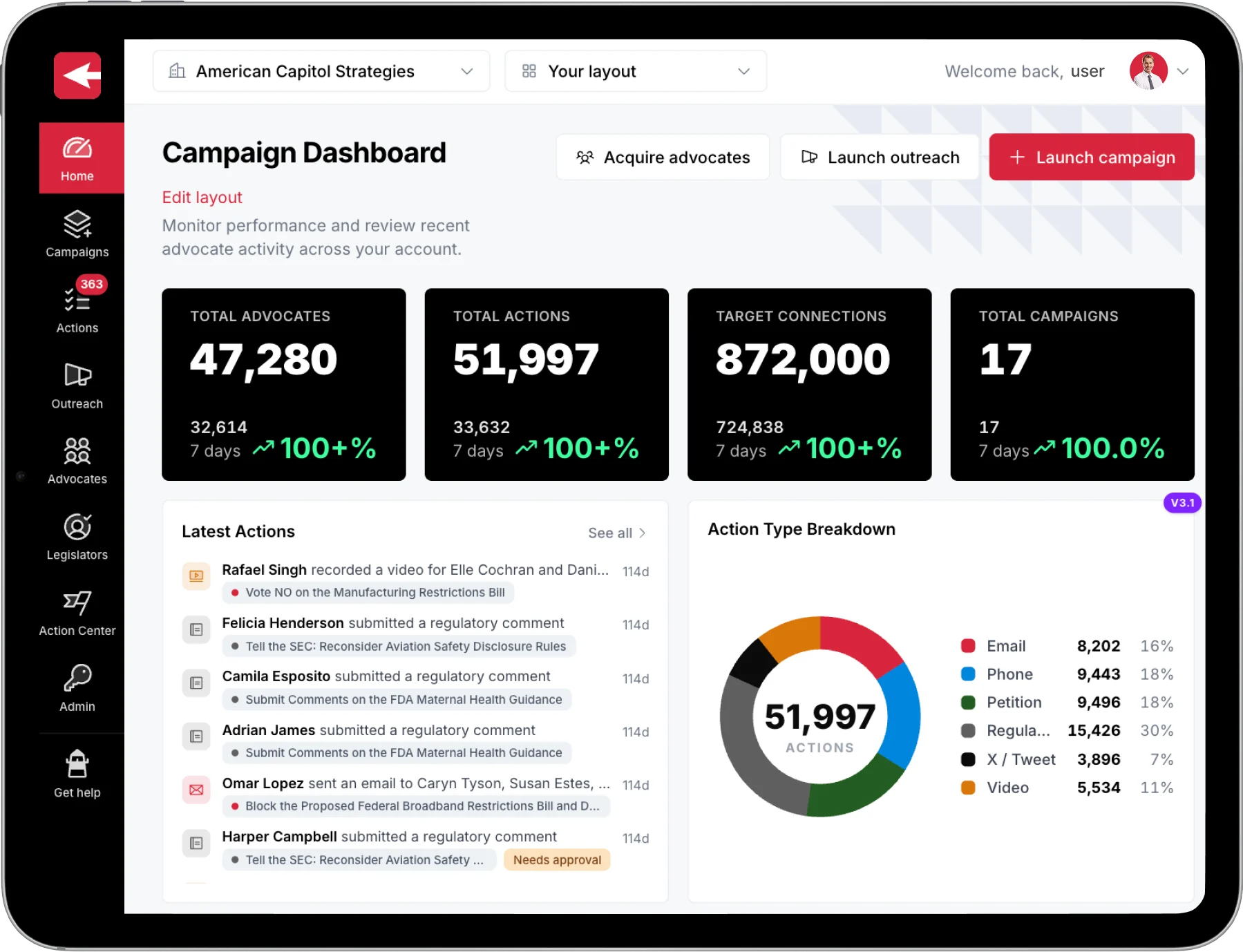
Dashboards that show who acts, when they act, and why they act allow advocacy teams to scale what works and fix what doesn’t.
11. Every Campaign Has Seasons
Early list-building, rapid response, coalition work, and long-term pressure all require different approaches.
CiviClick gives teams the flexibility to adapt without rebuilding their strategy every time.
12. Growth Comes From Relentless Focus on the User
Advocacy grows when it’s easy.
Thirty-second actions. Clear personalization. No friction. No confusion.
13. Frictionless Experiences Change Industries
Just as modern payment platforms removed friction from transactions, modern advocacy must remove friction from participation.
Streamlined supporter journeys are how movements scale.
14. Small Messages Win Big Battles
Clear micro-scripts outperform long policy explanations.
When messages are simple, advocates feel confident using them, and lawmakers hear them more clearly.
15. Clear Thinking Produces Clear Outcomes
Urgency, clarity, and targeted asks outperform vague calls for support.
CiviClick structures campaigns around what actually drives decisions.
16. Simplicity Scales, Complexity Stalls
Tools that take months to adopt don’t win campaigns.
Elegant workflows that teams can use immediately do.
17. Organizational Health Is a Strategic Advantage
Alignment internally leads to engagement externally.
When teams share clarity of mission and message, supporter participation skyrockets.
18. What Gets Measured Gets Moved
Real-time visibility into actions taken, targets hit, and momentum gained turns advocacy from guesswork into strategy.
19. Small Actions Create Lasting Habits
Advocacy works best when participation feels natural.
Micro-actions and repeat engagement turn supporters into long-term champions.
20. Intensity and Speed Matter
High standards, faster execution, and urgency separate winning advocacy efforts from stalled ones.
Momentum is a strategy.
21. Operational Excellence Is the Hidden Engine
Advocacy teams perform best when they operate like product teams.
Systems, metrics, and execution discipline drive consistent results.
22. Test, Learn, Iterate
No message is perfect the first time.
Rapid experimentation and optimization are how advocacy adapts in real time.
23. Advocacy Is a Bet on Human Behavior
Every campaign is a calculated bet on attention, motivation, and timing.
Behavioral insight and predictive analytics improve the odds.
24. The CiviClick Philosophy
At its core, CiviClick is built on three principles:
- Behavioral science and data, not guesswork
- Intuitive design that removes friction
- Systems that turn supporters into advocates, and advocates into champions
This is advocacy built for 2026 and beyond.
Advocacy That’s Built to Win
Advocacy is no longer about broadcasting messages and hoping something sticks. It’s about systems that work, supporters who act, and teams that can measure what’s moving the needle in real time.
The 24 principles outlined above aren’t trends or tactics; they’re an operating framework. They reflect how high-performing organizations think about engagement, execution, and impact. When advocacy is treated with the same rigor as product development or revenue growth, results stop being unpredictable.
CiviClick was built around this reality. Not as a collection of tools, but as a platform designed to help organizations focus on what actually drives policy outcomes, action, clarity, and momentum.
If the next phase of advocacy demands higher standards, faster execution, and measurable impact, then the playbook needs to evolve with it.
This is what modern advocacy looks like.