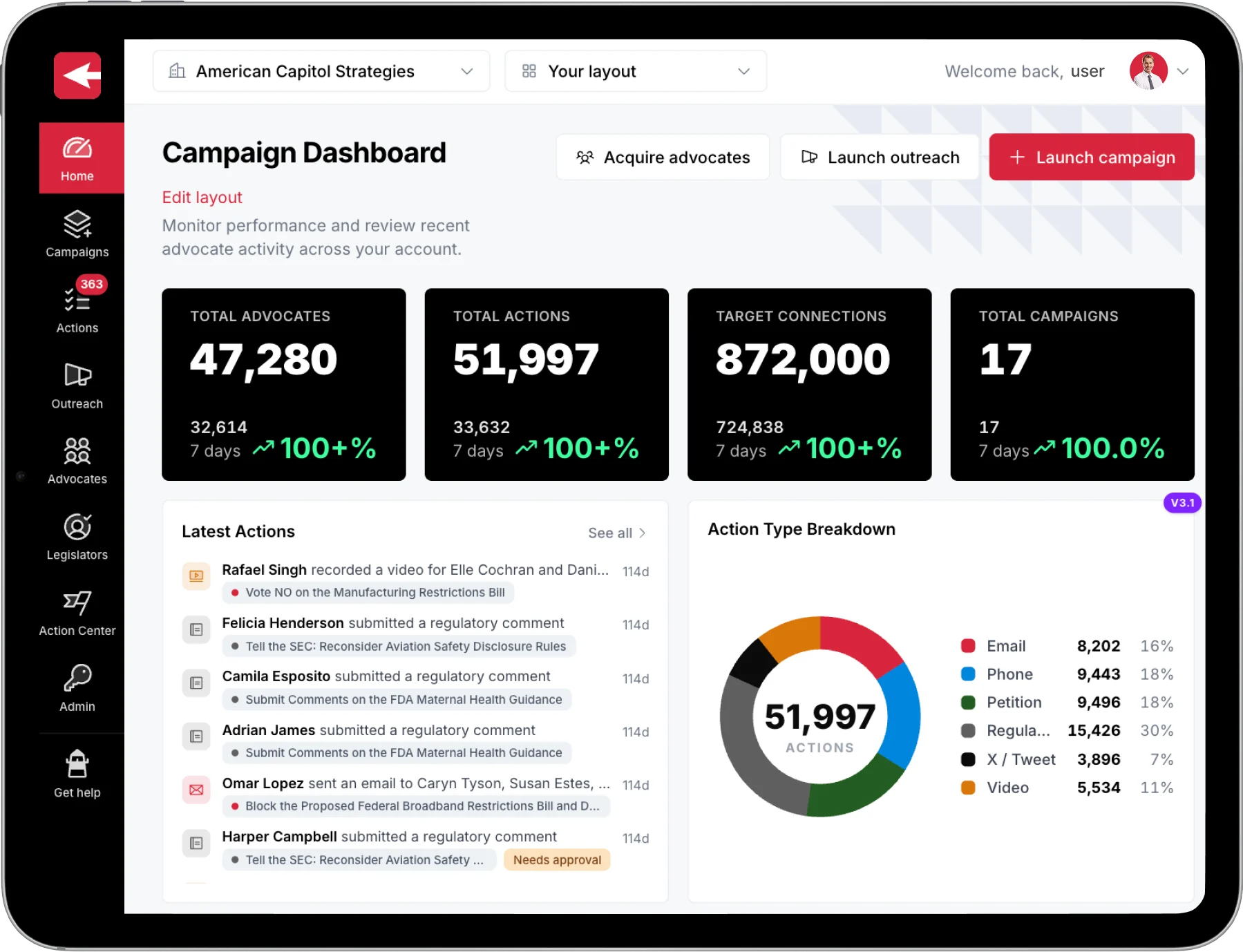











Advocacy Campaign Performance: How to Fix Supporter Drop-Off

A campaign can lose momentum long before a supporter reaches an action page. Strong advocacy programs identify every point where participation, message quality, targeting, or follow-up can break down, then improve the full path from outreach to policy impact.
An advocacy team sends an urgent alert. Supporters open it, some click, and a smaller group completes the requested action. The final report highlights the calls made, emails delivered, petition signatures collected, or comments submitted.
Those numbers matter, but they do not tell the entire story. They do not explain why some supporters never opened the alert, why others clicked and abandoned the action, whether the right legislative offices received meaningful constituent contact, or whether participants stayed engaged after the campaign ended.
Improving advocacy campaign performance requires a broader view. The goal is not simply to increase the number of people who reach the final confirmation screen. It is to connect the right supporters with the right action, direct that action toward the right decision-makers, and measure whether the campaign created useful pressure at the right moment.
The central question is not only, “How many people acted?”
It is also, “Who acted, what did they do, where was the action delivered, and did it help move the campaign toward its objective?”
Why Advocacy Campaigns Lose Supporters
Supporter drop-off is often treated as a landing-page problem. Sometimes it is. A slow page, a confusing form, or a poor mobile experience can stop a motivated advocate at the final step.
However, campaign leakage can begin much earlier. It can start with a broad audience list that ignores geography or issue interest. It can come from a vague message that never explains why the action matters now. It can happen when the requested action does not fit the legislative moment. It can even occur after a supporter acts, when the organization fails to acknowledge the effort or provide a meaningful next step.
A strong campaign review should examine the entire supporter journey, not just one conversion rate.
Seven Common Advocacy Campaign Leaks and How to Fix Them
1. The Campaign Reaches the Wrong Supporters
A large list does not automatically create a strong audience. When every supporter receives every alert, people are more likely to tune out messages that do not match their interests, location, or relationship to the issue.
Start with segmentation. Identify who lives in the districts that matter, who has previously engaged with the issue, who belongs to an affected profession or community, and who has demonstrated a willingness to take higher-commitment actions.
Geographic relevance is especially important in legislative advocacy. District-based segmentation helps teams focus on supporters whose elected officials are directly involved in the decision.
The fix is not necessarily to send fewer campaigns. It is to send more relevant campaigns to better-defined groups.
2. The Ask Is Too Generic
“Take action” tells a supporter almost nothing. It does not explain whether the next step is an email, a phone call, a petition, a public comment, or a meeting request. It also leaves the supporter uncertain about how much time or effort the action will require.
Make the request specific. Name the decision, the target, the action, and the timeframe whenever possible. For example:
- Call your state senator before Tuesday’s committee vote.
- Email the agency before the public comment period closes.
- Ask your representative to support the amendment this week.
Specific language reduces uncertainty and makes the campaign feel connected to a real policy moment. The same clarity should carry from the subject line to the button copy and the action-page headline.
3. The Action Does Not Match the Legislative Moment
Not every campaign should default to the same action. An email may be appropriate while an issue is gaining awareness. A patch-through call may be more useful immediately before a vote. A meeting request or in-district action may be more persuasive when a key lawmaker is undecided. A regulatory campaign may require formal comments submitted before a defined deadline.
The action should follow the strategy, not the platform’s default settings.
Before launching, ask:
- Which decision is the campaign trying to influence?
- Who has authority over that decision?
- Which supporters have standing with those decision-makers?
- What form of contact is most appropriate at this stage?
- When must the action arrive to remain useful?
Answering these questions helps prevent a campaign from generating activity that is disconnected from the actual policy process.
4. The Action Page Creates Unnecessary Friction
Once a supporter decides to act, the page should help them finish. Every unnecessary field, unclear instruction, or technical issue gives them another reason to stop.
Review the action page from the supporter’s perspective:
- Is the primary action visible immediately?
- Does the page explain what will happen after submission?
- Are all required fields genuinely necessary?
- Does address matching work without creating confusion?
- Is the message pre-drafted but editable?
- Can the action be completed comfortably on a phone?
- Does the confirmation message make it clear that the action succeeded?
Autofilled information, clear instructions, editable message guidance, and mobile-friendly forms can reduce effort without removing the supporter’s voice. CiviClick’s grassroots advocacy software supports personalized outreach, legislative targeting, multiple communication channels, and streamlined action experiences within one platform.
5. The Campaign Prioritizes Volume Over Message Quality
A high action count can create an impressive dashboard, but the number alone does not show whether the messages were credible, relevant, or persuasive.
Supporters should not be forced to write every message from scratch. That creates too much friction. They also should not be limited to an identical message with no opportunity to add personal context.
A better approach provides an accurate, approved starting point while allowing supporters to explain why the issue affects their family, organization, profession, business, or community. That balance preserves speed while encouraging more authentic constituent communication.
Low-barrier actions can be useful entry points, but they should not automatically be treated as the campaign’s final objective. Effective advocacy programs evaluate whether participation produces meaningful engagement rather than relying only on impressive send counts.
6. The Relationship Ends After the First Action
A completed action should begin the next stage of engagement. Too many campaigns send a thank-you message, record the action, and then return the supporter to the same general mailing list.
Use the campaign to learn more about each participant. A first-time petition signer may be ready for a future email action. A repeat participant may be willing to make a call. A highly engaged constituent may be a strong candidate for a meeting, testimony, a local event, a personal story, or a leadership role within the advocate community.
Progressive engagement helps organizations develop durable advocacy capacity rather than repeatedly rebuilding participation from scratch. It also gives supporters actions that match their demonstrated level of interest and commitment.
7. The Team Measures Activity Instead of Performance
Open rates and action counts are useful, but they are not the same as advocacy outcomes. Campaign reporting should show where people entered the process, where they stopped, which audiences performed best, and what happened after the contact reached its target.
A campaign that produces fewer actions from highly relevant constituents in priority districts may be more strategically valuable than a large national response that reaches offices with no role in the decision.
The solution is to connect communication metrics, participation metrics, targeting data, and policy outcomes. CiviClick’s guide to measuring digital advocacy success provides additional context on aligning campaign metrics with organizational goals.
Which Advocacy Campaign Metrics Matter Most?
The right advocacy campaign KPIs depend on the campaign objective, but most teams should review performance at four levels.
Audience and Delivery Metrics
- Messages delivered
- Bounce or delivery failure rates
- Audience size by segment
- Participation by district, state, issue interest, or supporter type
These metrics show whether the campaign reached the intended audience and whether the underlying supporter data is reliable enough for targeted mobilization.
Engagement and Conversion Metrics
- Email open rate
- Click-through rate
- Action-page visits
- Action completion rate
- Form abandonment rate
- Mobile and desktop completion differences
These figures help locate friction. If opens are strong but clicks are weak, the ask or button may be unclear. If clicks are strong but completions are low, review the action page, required fields, message experience, and technical performance.
Advocate Development Metrics
- First-time participants
- Repeat participation
- Supporters advancing to higher-commitment actions
- Personal stories collected
- Participation across multiple channels
These metrics reveal whether the organization is building a stronger constituent base or simply generating isolated actions.
Policy and Decision-Maker Metrics
- Contacts delivered to priority offices
- Responses from lawmakers or staff
- Meetings or follow-up conversations generated
- Public comments successfully submitted
- Movement in a vote, amendment, regulation, or public position
- Progress toward the campaign’s defined policy goal
These results can be harder to attribute than email or page activity, but they are more closely connected to whether the advocacy strategy is working.
How to Build a Repeatable Campaign Optimization Process
Campaign optimization should not begin after disappointing results. Build it into the planning process.
- Define the policy objective. State the decision, target, timeframe, and desired outcome before choosing tactics.
- Map the supporter journey. Document every step from receiving the alert to completing the action and receiving follow-up.
- Choose one primary action. Secondary requests should not compete with the main campaign objective.
- Segment before sending. Use geography, interest, engagement history, stakeholder type, and relationship to the issue.
- Test the complete experience. Review the message, link, action page, form, routing, submission, confirmation, and follow-up on desktop and mobile.
- Track each stage separately. Do not combine clicks and completed actions into one broad response metric.
- Review quality and outcome. Examine who acted, what they sent, where it went, and what changed after delivery.
- Apply what you learn. Use the results to improve future segmentation, messages, timing, channels, and supporter pathways.
The most useful campaign report should help the team make a decision. It should reveal what to repeat, what to change, and which supporters are ready for the next action.
How CiviClick Supports Stronger Advocacy Campaign Performance
CiviClick is built for associations, nonprofits, companies, agencies, and public affairs teams that need to coordinate real constituent action at scale.
The platform brings campaign creation, supporter segmentation, legislative targeting, personalized messaging, multichannel communications, action tools, and reporting into one connected advocacy workflow.
That connected approach matters because campaign performance problems rarely exist in isolation. Targeting affects message relevance. Message relevance affects participation. Action design affects completion. Reporting determines whether the team can identify the problem and improve the next campaign.
Technology cannot replace campaign strategy or authentic constituent relationships. It can make both easier to execute, measure, and refine.
Build Advocacy Campaigns Around Results
Strong advocacy programs do more than generate clicks. They activate relevant supporters, deliver meaningful constituent contact, and give campaign teams the data needed to improve over time.
See how CiviClick can help your organization plan, launch, target, and measure high-impact grassroots advocacy campaigns.
Frequently Asked Questions
What Is Advocacy Campaign Performance?
Advocacy campaign performance is the degree to which a campaign reaches the right supporters, motivates them to complete meaningful actions, delivers those actions to the appropriate decision-makers, and contributes to the campaign’s policy objective.
How Can Advocacy Teams Reduce Supporter Drop-Off?
Teams can reduce drop-off by segmenting outreach, making the ask specific, matching the action to the legislative moment, minimizing unnecessary form fields, improving mobile usability, providing editable message guidance, and following up after the initial action.
Which Advocacy Campaign Metrics Should Teams Track?
Useful metrics include delivery rates, open rates, click-through rates, action-page visits, action completion rates, participation by district, repeat participation, message or call delivery, lawmaker responses, and progress toward the campaign’s policy goal.
Why Do Supporters Click but Not Complete an Advocacy Action?
Supporters may abandon an action because the page is slow, the form asks for too much information, the mobile experience is difficult, the requested action is unclear, the message requires too much work, or the page does not clearly confirm what will happen next.
How Can Advocacy Software Improve Campaign Performance?
Advocacy software can centralize supporter data, segment audiences, match constituents to decision-makers, support multiple communication channels, simplify action pages, personalize outreach, and provide reporting that helps teams identify where campaign performance can improve.