









Patch-Through Calls vs Email-to-Legislator: When Each Channel Wins

Choosing the right channel at the right moment can decide outcomes. For public affairs, government relations, corporate advocacy, and association teams, the late-funnel decision often comes down to two direct-to-office tools: patch-through calls and emails to legislators. Both are effective. Both can scale. But they excel in different scenarios, timelines, and budget realities. This guide lays out a practical framework to help you pick the right lead channel, avoid common pitfalls, and build a cadence that wins.
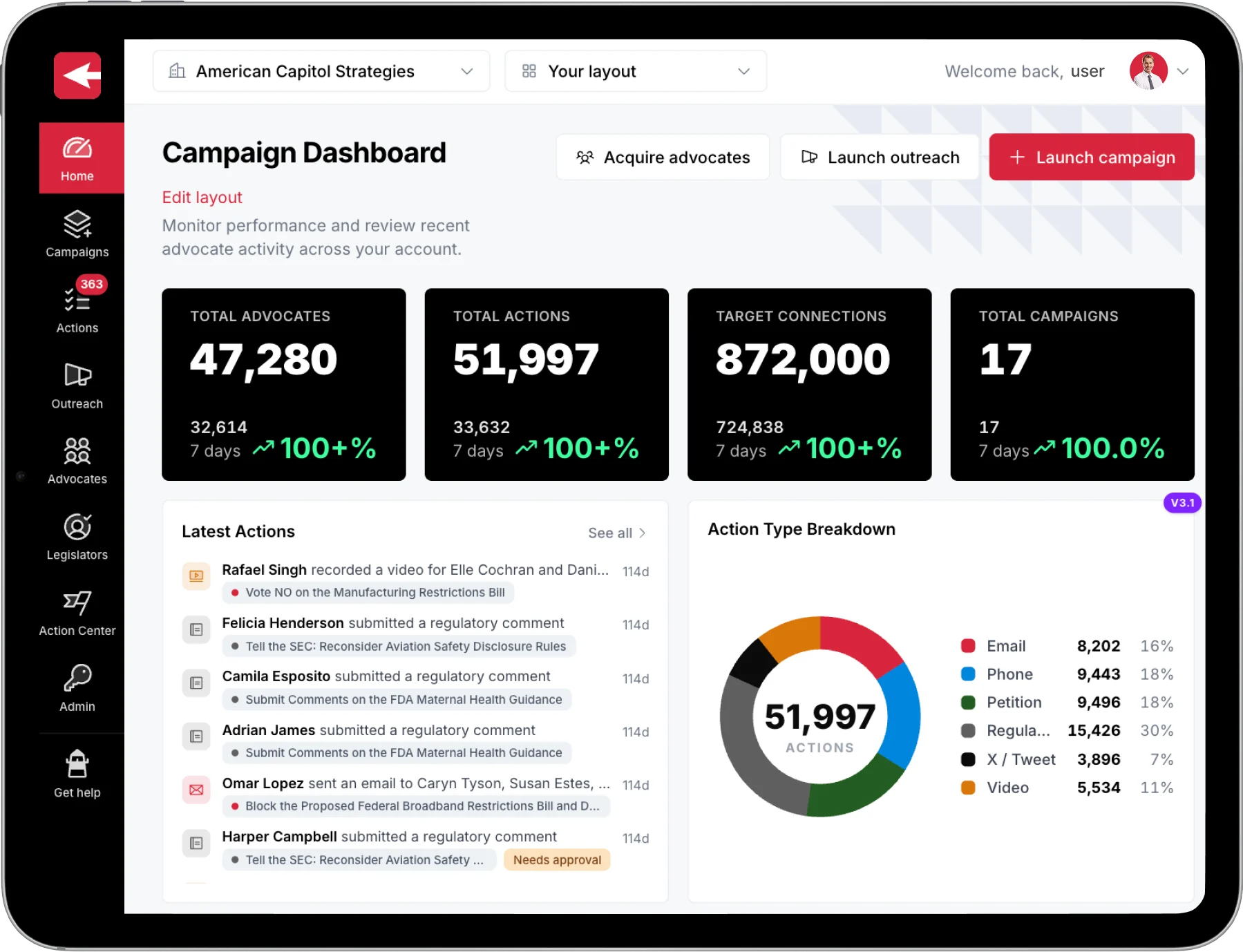
CiviClick supports advocacy teams with tools to mobilize supporters to contact elected officials via phone and email within a unified workflow. The guidance below focuses on operational execution, compliance, and measurement so you can make clear choices with confidence.
Key Takeaways
- Patch-through calls (advocacy calling) connect supporters by phone to the correct office with a concise message. They win when the stakes are high, timing is tight, and the target map is narrow.
- Email to legislator scales fast, routes messages to the right office, and creates a durable written record. It wins when you need breadth, education, and sustained pressure.
- Most campaigns benefit from both: email for volume and narrative, patch through calls for urgency and salience. Choose based on timing, target size, message complexity, staffing, and compliance needs.
Quick Definitions: Keep Teams Aligned
What are patch-through calls?
Patch-through calls are advocacy calls that “patch” a supporter directly to their elected official’s office after a short introduction or script. Supporters hear a brief message with two to four talking points and a single clear ask. They are then connected to the appropriate office to deliver that message in their own words.
Why it matters: Legislative offices often log calls by issue and position. A burst of constituent calls during a decision window signals intensity and focus.
What is email to a legislator?
“Email to legislator” refers to routed digital messages sent by constituents to their elected officials and staff. Supporters typically submit a pre-drafted note with optional personalization and clear contact details so the office can verify residency and tally sentiment.
Why it matters: Email is built for scale. It documents arguments in writing, reaches many offices and districts quickly, and sustains pressure over the course of weeks.
The Decision Framework at a Glance
- Objective
- Persuade or pressure a small number of swing offices → patch-through calls
- Demonstrate breadth of constituent sentiment across many districts → email to legislator
- Secure meetings or slow down a bill or rule → start with email; concentrate calls on key offices as the calendar firms up
- Urgency and timing
- Hours to a few days before a vote or hearing → calls carry more weight
- Multi-week education and coalition-building → email lays the groundwork
- Target universe
- Narrow map (for example, 5–25 offices) → calls win
- Broad map (multi-state or hundreds of districts) → email wins
- Message complexity
- Simple, high-salience ask → calls
- Complex issues needing context and links → email
- Budget and staffing
- Higher unit cost, higher salience → calls
- Lower unit cost, massive reach → email
- Measurement and optics
- Calls: “the phones lit up” moments get noticed
- Email: volume and record-building across a wide footprint
When Patch-Through Calls Win
Patch-through calls shine when you need intensity in a tight window. Offices feel the pressure when their phones ring steadily with focused, respectful messages from constituents.
Use cases:
- The final 24–72 hours before a key vote or amendment
- Persuading committee chairs or swing members
- Countering a last-minute narrative around a product restriction, new tax, or mandate that would raise costs, limit consumer choice, or threaten jobs
Why it works:
- Immediacy: Live calls are difficult to ignore. Staff are logging and escalating tallies in real time.
- Perceived effort: Phone calls are seen as higher-effort actions than many digital touches, signaling stronger intensity.
- Focus: With a disciplined script and a single clear ask, calls reduce ambiguity and keep the conversation on the key point.
Execution checklist:
- Targeting: Build a tight list of offices, committee members, and leadership, prioritize where phones matter most.
- Script discipline: Keep it short (two to four points), specific (bill number and position), and respectful.
- Timing: Align calling windows to office hours; monitor live answer vs voicemail rates and adjust.
- Training and QA: Provide FAQs and guardrails so agents and supporters stay on message; monitor for tone and accuracy.
- Reporting: Track calls per office, connect rates, and sentiment so you can adjust targets daily.
Risks to manage:
- Call fatigue if volume isn’t paced; rotate targets and pacing to avoid overwhelming small offices.
- Off-hours voicemail surges that don’t get tallied the same way as live calls.
- Message drift without tight scripting and monitoring.
When Email to Legislators Wins
“Email to legislator” is the backbone of scale. It accelerates outreach across large districts, enables personalization at low friction, and creates a written record that can be referenced during staff briefings.
Use cases:
- Broad, multi-state campaigns requiring thousands of constituents to weigh in
- Education-heavy issues (technical standards, licensing, compliance) where context and links help
- Early-stage pressure that needs to be sustained through a session or regulatory timeline
Why it works:
- Scale: Supporters can act in seconds, enabling fast volume growth across many districts.
- Documentation: Offices log emails by topic and position; written messages help staff quantify sentiment and understand arguments.
- Segmentation: You can tailor language to different districts or committees without changing the core ask.
Execution checklist:
- Data integrity: Match constituents to districts accurately; verify addresses to avoid misroutes.
- Message design: Offer a concise pre-drafted note with optional personalization; include bill numbers and a clear ask.
- Deliverability: Authenticate sending domains, stagger sends to avoid filters, and track bounces.
- Segmentation and pacing: Send during business hours, and sequence waves by state, district, or committee priority.
- Measurement: Monitor send volume, delivery, open rate proxies where available, and office responses.
Risks to manage:
- Inbox saturation with generic form language; encourage a short, personalized paragraph.
- Poor targeting or unverified addresses that reduce credibility.
- Overlong emails that depress completion rates.
Budget and ROI Thinking
Patch-through calls and email-to-legislator have different cost structures and return profiles. The right mix depends on your win condition.
Cost dynamics:
- Patch-through calls: Higher cost per action, higher salience. Best when flipping or securing a small number of offices can decide the outcome.
- Email to legislator: Lower cost per action and massive reach. Best for demonstrating breadth, educating decision-makers, and sustaining attention.
Modeling impact:
- Define your win condition: Are you flipping five swing votes, securing a meeting with leadership, stalling a bill in committee, or shaping amendments?
- Estimate the required scale: For calls, estimate the calls-per-office needed to be noticed. For email, estimate district coverage and volume needed to register.
- Watch marginal returns: After a threshold, returns diminish. That’s the moment to layer the second channel rather than oversaturate the first.
Practical budgeting:
- Keep an “always-on” email cadence to educate, build lists, and document constituent sentiment.
- Hold a rapid-response reserve for patch-through calls in the final 48–72 hours before key decisions.
- As calendars shift, pivot budget between channels based on response signals and whip counts.
Compliance and Reputational Safeguards
Executing advocacy calling and email to legislators at scale requires discipline.
- Consent and preferences: Obtain appropriate consent, respect opt-outs, and keep a clean record of supporter preferences.
- Calling rules: Respect calling hours, comply with applicable telemarketing and recording laws, and train agents on approved statements.
- Email standards: Authenticate domains, avoid spammy language, and use secure links to supporting information rather than attachments.
- Constituent integrity: Accurately match messages to districts; avoid routing non-constituent communications that can undermine credibility.
- Documentation: Store scripts, message copy, targeting criteria, and campaign logs. Documentation helps ensure consistency and supports internal review.
How Offices Actually Process Calls and Emails
Understanding office workflow helps you tailor your approach.
- Calls: Front desks and staff typically log caller location, issue, and position. A concentrated volume in a short window is noticed and often escalated in internal briefings. Short, respectful, single-issue calls are easiest to log and tally.
- Emails: Offices route and sort by topic and address. Personalized notes with a clear ask and specific bill numbers get more attention than generic form text. Volume across many districts shows breadth; district-accurate messages protect credibility.
Implication: Keep calls simple and timely; keep emails concise, verifiable, and easy to tally.
A Simple Decision Tree
- Is the vote or hearing within 72 hours, and the target map under 20 offices?
- Lead with patch-through calls. Use a tight script and report daily tallies. Support with email for broader coverage.
- Do you need 10,000+ constituent touches across many districts over multiple weeks?
- Lead with an email to the legislator. Segment by district and committee, then layer calls into swing offices as calendars firm up.
- Is the issue complex and education-heavy?
- Start with an email to build understanding and credibility. When dates are set, add calls to drive urgency.
- Do leadership or chairs need to feel intensity from constituents?
- Concentrate calls and time them during business hours. Report call volume, sentiment, and any meeting requests.
Always be ready to pivot. Legislative calendars move fast; the winning channel today might shift tomorrow.
Real-World Style Scenario
Situation: A state bill proposes a product restriction that would limit consumer choice and increase costs. The committee vote is in 10 days; a floor vote may follow within three weeks.
Plan:
- Week 1: Launch email-to-legislator across targeted districts with a concise message citing bill number, the economic impact, and a clear ask to oppose the restriction. Provide an optional paragraph for supporters to describe how the change affects their household or job.
- Days 8–10: Execute patch-through calls into the committee’s swing members. Use a disciplined script with two to three points and a single clear ask tied to the bill number.
- After committee: Expand email volume district-wide to keep the narrative consistent. If margins look tight before the floor vote, run a 48-hour call surge to the decisive offices.
- Parallel tracking: Monitor per-office calls, emails by district, and office responses. Shift targets as new intel arrives.
Outcome logic:
- Email builds breadth and documents arguments early.
- Patch-through calls tighten the screws at the moment of decision.
Common Pitfalls, and How to Avoid Them
- Vague asks: Always include a specific action tied to a bill or docket number.
- Overlong scripts or emails: Keep calls to two to four talking points and emails to a few short paragraphs.
- Poor timing: Don’t launch call surges when offices are closed. Time email waves to business hours.
- Bad targeting: Confirm districts, committee assignments, and leadership roles. Don’t waste touches.
- Inconsistent tone: Use respectful, fact-focused language that’s easy for offices to log.
- No follow-up plan: Close the loop with supporters, report progress, and sustain momentum into the next phase.
Bringing It Together in One Plan
The most reliable formula is simple:
- Use email to the legislator as your scale engine for education, breadth, and documentation.
- Use patch-through calls to concentrate intensity on a narrow map when timing is critical.
- Build a cadence: educate early, surge calls near the vote, and keep a rapid-response reserve to handle last-minute changes.
- Measure what matters: report daily tallies by office, track connect rates and deliverability, and tie every action to your win condition (votes, meetings, amendments, or delay).
How CiviClick Helps
CiviClick provides advocacy software designed to mobilize supporters to contact elected officials through channels like phone and email. Teams use these tools to:
- Activate patch-through calls with disciplined scripts and targeted outreach
- Launch email-to-legislator campaigns that scale quickly and route messages accurately
- Track performance with clear analytics so you can pivot fast as calendars shift
Ready to pick the right mix for your map and timeline? Talk to CiviClick about planning and executing patch-through calls and email-to-legislator outreach within a unified, data-driven workflow.